
Why Cost and Perceived Value Rarely Align
Updated: Feb 11

We are often asked why certain fabrics feel expensive, while others, sometimes far more costly - do not.
The answer is rarely price. And it is almost never decoration. In interior design, particularly within large residential and commercial projects, perceived value is shaped less by cost and more by behavior. How a fabric sits within architecture. How it performs at scale. How it continues to feel appropriate over time.
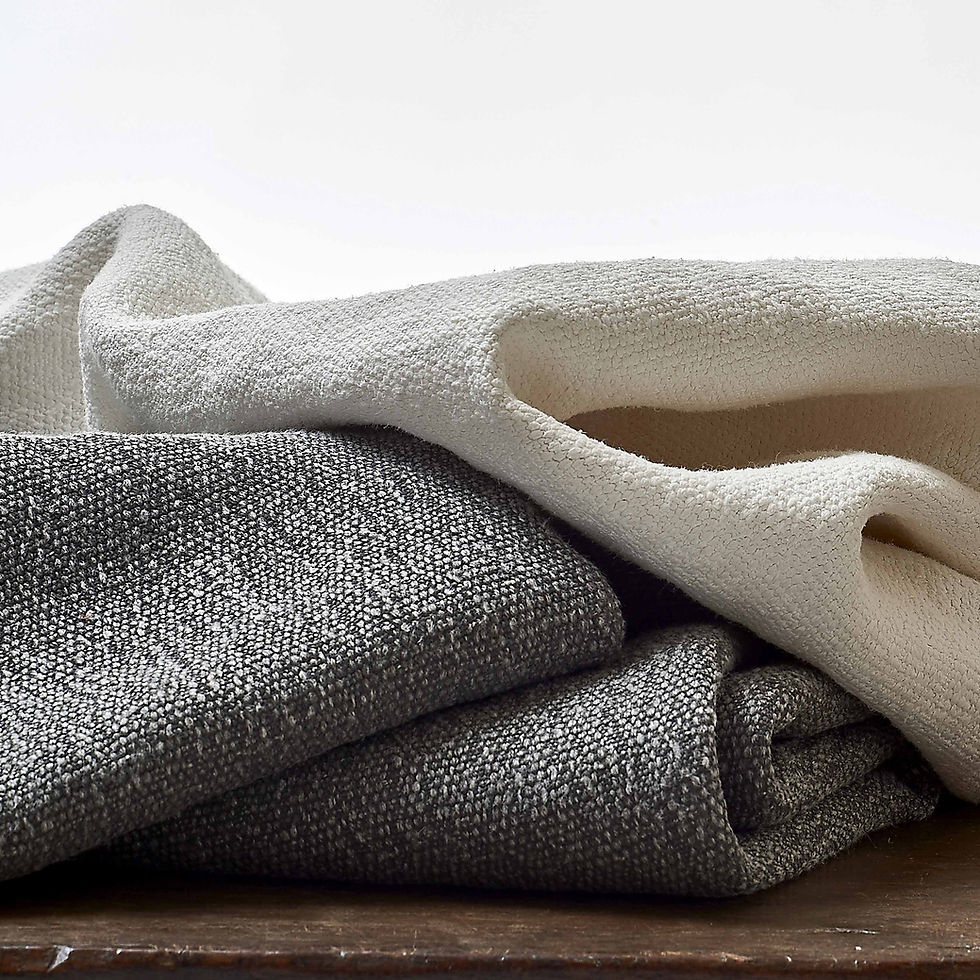
What tends to endure is restraint - materials that have depth without noise, and presence without insisting on attention. Fabrics that sit comfortably within a space, rather than competing with it. Their quality may not be immediately obvious, but it becomes clear with use.
Restraint, Depth and Perceived Value
Cost reflects many factors: production methods, materials, labour, and provenance. These matter, but they do not guarantee that a fabric will read as valuable once installed.
Fabrics that feel expensive tend to be composed. They rely less on surface effect and more on balance of weave, texture, weight and proportion. Their interest is embedded rather than applied.
By contrast, a costly fabric that depends on strong pattern or contrast can feel impressive in isolation, yet unsettled at scale. Price does not prevent a material from becoming visually noisy. Perceived value comes from control, not excess.
Scale and the Reality of Interiors
Scale plays a part. So does weight. A fabric that appears engaging on a sample can feel restless once it fills a room. Repetition amplifies everything, both strengths and weaknesses. What felt expressive in the hand can become insistent on the wall.
The opposite is also true. Quieter fabrics often reveal their quality only when given space. In larger interiors, subtle texture and rhythm begin to register more clearly. The material settles. It feels considered rather than imposed.
In practice, calmness at scale often carries more value than complexity.
Distance, Use and Experience
We also pay close attention to how a fabric reads from a distance. Interiors are rarely experienced close-up alone. Materials must hold themselves across rooms, down corridors, and through layered sightlines. Fabrics that read as valuable retain their coherence. They do not fragment or dissolve into visual noise.
This distinction becomes particularly clear in hospitality and commercial interiors, where fabrics are seen repeatedly and under changing conditions. Materials that maintain their presence over time tend to feel more valuable than those designed to impress quickly.
Longevity as a Measure of Value
Perhaps the clearest reason cost and perceived value rarely align is time. Fabrics that rely on first impressions often date quickly, regardless of their original price. Those that hold their ground quietly tend to endure. They sit comfortably within architecture. They remain appropriate as spaces evolve.
This is the thinking that guides our edit at Alton-Brooke. We look for materials whose value is felt rather than announced, fabrics chosen for how they behave over time, not how they present initially.
Not those that rely on cost to signal quality, but those that reward long use and close consideration.


Comments